
These are interesting times for leaders. Technology is changing the game every day, there is increasing competition for good jobs, and the international economic climate is as fickle as the weather in London. If you are like most of the executives I coach it’s hard to find the time to sit down and contemplate where your career is going. But how can you be a good self-leader if you don’t know exactly where you are leading yourself to?
As Laurence Peter, author of The Peter Principle wrote, “If you don’t know where you are going, you will probably end up somewhere else.”
That’s why the most important question to ask yourself as a self-leader is: “What do I really want long-term in my career?”
You’re no longer at a level where you can leave your fate to “the powers that be” at headquarters or even to your immediate boss. If you wait for something outside of your control to change, you could end up waiting a very long time. So, in reality, there is nobody better than you to look at the big picture and set the direction for the next move in your career.
Take my coaching client, Scott, as an example. A very successful lawyer in a large multinational firm, Scott hadn’t taken the time to look at his career in a “big picture” way. Don’t get me wrong— he was progressing up the ladder, and quite nicely at that—but not in a strategic way. He was simply moving along from job to job. He had no long-term perspective because he had gotten too caught up in each position’s specific set of responsibilities and was only focusing on how to move forward to the next one. He had never thought about how each job could actually position him for much longer-term success.
Scott said to me (and I hear this a lot), “The truth is, Brenda, I’ve just been lucky all my career. The companies and opportunities have simply come to me; I didn’t need to plan or strategize.”
If this sounds familiar to you, I may know why. Early in your career, it isn’t unusual for the next opportunity to just land in your lap. You produce, you deliver, and doing so results in more jobs and more opportunities appearing on the horizon.
But as you move up the ladder to increasingly senior positions, the sheer number of jobs at that level diminishes. It becomes important to shift from being reactive—simply choosing from among the various positions that are presented to you—to being proactive. When you are proactive, you ask yourself the important questions that can change the trajectory of your professional life for the better: Is my current position likely to lead me where I want to go? In order to reach my long-term goal, what makes the most strategic sense for my career – short-term, medium-term, and long-term?
A Career with a View
It’s one thing to say that you want to look at your career from a strategic vantage point, but how do you actually do that?
To do this for Scott, he and I worked through what I call the “End-Point Exercise.” You can try it, too:
- First, draw a horizontal timeline with this year’s date at the farthest-left end of the line. Then, reflect: At what age will you retire and/or quit working full-time? Be transparent with yourself. How many years do you honestly have remaining in your career? 10? 15? 20?
- Write that retirement year at the furthest-right end of your timeline.
- Then, ask yourself:
- What does “success” look like at that final stage?
- What do I want to be doing by then?
- What is my ideal final post in my career?
- Spend some time visioning what your life will look like at that point. Don’t limit your vision to your work life; think also about where you want to be with your family/personal life, community, spiritual life, philanthropy-all aspects of what is important to you.
Your “ideal” might be having the financial means to never have to—or want to—work again. Maybe you would like to take on an independent director board position, work part-time, or even start a business of your own, either for fun or for additional income. Your vision might include making sure you have enough money coming in for your children’s university tuition and for your own retirement years. You might want to live in another country, spend more time with family, travel, or simply live the life you want as a happy, healthy retiree. But how do you make sure you get there?
This first step is key. You must be crystal clear in your mind about your “end game.” Don’t move forward with any other steps until you’re absolutely certain that you have clarity about where you are headed.
To help you with this, I encourage you to create a vision for yourself. It can be a written narrative or a pictorial vision (with photos or magazine visuals that you pull together)—or it can be a combination of both. Be specific. You may want to talk about or develop your vision with your spouse or your significant other to assure that you have the same end game in mind.
Once you are crystal clear on the desired outcome, here’s how to make this vision come to life: Envision that it is the last day of your work life. You’ve fast-forwarded to the year you’ve written at the farthest-right end of the timeline you drew.
Try it now! In your mind, imagine you are at your retirement party, and a big banquet has been organized in your honor. You are seated at the head table. All of your past and current coworkers are there to celebrate your life and career—your direct reports, peers, bosses, suppliers, and industry colleagues. Each of those individuals is standing up, one by one, and paying tribute to you. What will they say about you in general? About what you did? About the specific contributions you made? About the kind of person you are? What would you like to hear them say as you sit there, listening to speech after speech?
Then, ask yourself this fundamental question: What will I need to do, and how will I need to be, to get to that point and deserve those accolades?
It helps to take a 360-degree approach to this exercise and look at the situation holistically:
- What character traits will you need to hone and polish?
- What specific skill sets will be key to your success?
- How much money will you need or want to have by then?
- What kinds of networks and connections will you require?
Create a list for yourself, and keep adding until you’ve written down all of the skills, attributes, and actions that you will need to get you to where you want to be.
Once that is clear, come back to the reality of today, and ask yourself: How would you rate yourself in each of those individual areas now? If the “end game” is a 10 (on a scale of 1 to 10, with 10 being high), how would you score yourself today in each specific area?
This assessment allows you to get crystal clear about (a) how well you are honestly doing now, and (b) where you will need to place the most focus between now and then. Which of your skills and talents need strengthening in order to achieve your goals by the end date? Get specific.
As I walked Scott through the End-Point Exercise, he realized that he had aspirations to be a General Counsel in a large multinational corporation. That would involve carefully plotting his career to include new skills—both in the legal field and with people-leadership—that he hadn’t previously considered. He also would need to network across other areas of the larger organization where he worked—within divisions where he hadn’t made connections in the past. This prompted Scott to set up a series of lunches and coffees with various high-level leaders from other areas of the organization. It was a great example of being proactive and taking self-leadership in career planning to a whole new level.
This is how you develop a concrete plan to plot your career strategically and make sure you’re on track to end up where you want to be!
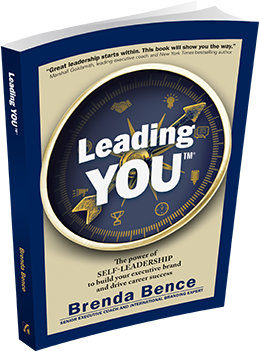
LEADING YOU™
The most important driver of overall success is your own self-leadership. How you lead yourself directly impacts your ability to lead others, and that, in turn, can prevent you from reaching your full potential.
Discover the power of SELF-LEADERSHIP to build your executive brand and drive career success.
 Brenda Bence is a globally recognized High-Stakes C-Suite Succession Coach and Executive Leadership Advisor, trusted by the world’s most influential organizations to navigate high-level leadership challenges and pivotal transitions with clarity and confidence.

