Attention College Grads! How to Use a Post-Interview Thank You Note to Land the Job You Want

by | Excellence in Leadership

Employers want to know why you are the best choice for the job. Should they hire you or another candidate? But here’s a surprising truth: The person who best connects with the interviewer is most likely to get the job – even over someone who might be more qualified. That’s where your personal brand comes in.

Maybe you’re thinking, “A personal brand? I don’t have one or even want one!” Reality is, though, you do already have a personal brand whether you realize it or not. Just by being you in interviews, on the job, or wherever you present yourself, you have a personal brand. Defined as “the way you want people to perceive, think, and feel about you in relation to others,” your personal brand is alive and well and exists in the minds of other people – including interviewers.
That’s why it’s important to take control of your brand, to make sure you make the impression you want throughout your job search.

So, learning to master your personal brand is key to success, and one way to do that is to avoid the Top 10 Job-Seeker Personal Brand Busters®. These, listed below, are among the most damaging mistakes that job seekers make when looking for a new position. Avoid these Busters™, and you’ll communicate a more powerful personal brand to potential employers before, during, and after your interviews.

In your job search efforts, have you committed any of these Job-Seeker Personal Brand Busters®?

1. Not paying attention to your personal brand on the Internet. Chances are, your interviewer or future boss will search for your name on the Internet prior to your interview. So, think twice before posting those wild photos from Mardi Gras on your Facebook page. If you blog or use Twitter, pay attention to what you say. Avoid writing negative comments about others (especially former employers and coworkers), and steer away from profanity and strong opinions.
2. Not visiting the restroom prior to your interview. Ok, let’s get the obvious out of the way: You definitely don’t want to squirm in your chair because you haven’t had time to go to the restroom before the interview! But you should also use a quick pop into the restroom to make sure your hair is neat, your suit hasn’t picked up any lint, and everything is in its proper place.
3. Answering a question without taking the time to think or before fully understanding the question. Let’s say you’re in an important interview, and you’re asked a question that takes you by surprise. You’re not sure how to respond, but you feel you need to say something right away to make you look confident. So, you just start babbling, spouting out whatever comes to mind. The truth is that interviewers actually prefer that you pause for a few seconds to think of a good answer before you speak. If you rush to answer every question, you run the risk of saying something you don’t really mean.
4. Only looking at one interviewer when there are two or more interviewers in the room. Job seekers tend to look at the interviewer who is most expressive or seems the most receptive. But if you’re interviewed by more than one person, make sure you look at everyone in the room when you speak. Make eye contact with one interviewer for a few seconds, then shift to another and another in order to connect with all of them.
5. Talking only about what you want out of the job and not what the company needs or wants. The employer is more interested in what you can do for the company and not vice versa. If you’re asked in the interview what you want from the job, answer the question intelligently, but don’t go on and on about all that you’re hoping the company can offer you.
6. Speaking negatively about your current or former employer. This was confirmed in a survey of interviewers and recruiters conducted by CareerBuilders.com where 49% said that the worst interview offense is speaking negatively about a former boss. Saying something mean-spirited about a former employer will leave a bad taste in an interviewer’s mouth, so find a way to shed some positive light on your current or previous company and boss.
7. Asking questions about pay and benefits during an initial interview. Recruiters say they immediately read that kind of question as a sign of someone with little experience. It’s okay to ask an employment agent or recruiter about salary and benefits, but an initial interview isn’t the right time to ask those questions unless the interviewer brings it up. You can cover those subjects once you’re further along the interview process.
8. Not asking questions in a way that helps sell yourself. Ask questions in a way that highlights your strengths. For example, you could ask something like: “Given my experience managing big projects in my current job, do you see opportunities for someone like me to take on a project manager role here, too?”
9. Not being prepared with good, thoughtful questions to ask at the end of an interview. Being prepared with smart questions about the company and the job will show you’ve done your research. It demonstrates that you want to be a part of the organization and that you’re taking the process seriously.
10. Beating yourself up if you don’t do well in an interview or if you don’t get the job. You may have done better in the interview than you think, and the company’s reasons for not choosing you may have nothing to do with you at all. The company might have decided to eliminate the position entirely, or they may have chosen someone from within. So, don’t let a less-than-stellar experience turn you into a pessimist. Stay positive! Evidence shows that people who are optimistic about their job search actually get jobs more quickly.

Statistics show that, on average, only about 10% of college grads write a thank you note after an interview. So, should you? Absolutely! It’s a great way to distinguish yourself from the sea of other candidates, and it will help your individual personal brand stay memorable. In fact, if you’re in the “maybe” pile when you leave the interview, a well-thought-out thank you could easily move you to the “yes” pile.

After contacting over 50 of the country’s top recruiters, I learned dozens of powerful tips that they suggest college grads consider during their job search.

Here are some of those tips for making your follow-up thank you note a powerful statement that will help you build your college graduate personal brand and land a great job:

Personalize it!

If you send a “cookie-cutter” thank you that sounds like it’s the same one you send to everyone after an interview, you could easily be moved from the “maybe” pile to the “rejected” pile. So, no cutting and pasting! Mention something specific that happened in the interview to help the interviewer remember you. One company recruiter says, “It shows that you were listening and paying attention.” She suggests writing something like, “I really liked the culture of the company, and I feel I can contribute in that kind of environment because…”

Express your interest in the job.

Be enthusiastic about it! Be willing to show your excitement and passion.

Remind the interviewer what you can offer.

Mention why you believe you’re a great fit for the job. Veda Jeffries, Assistant Director of Counseling Services at Stanford University, says a well-written thank you note “gives you an opportunity to reiterate or point out a skill you may have overlooked during the interview.”

Don’t forget anyone.

If you interviewed with more than one person, send each of them a separate thank you note.

Proofread, proofread, proofread!

Triple-check the thank you note to make sure everything is correct — especially the interviewer’s name and title and the company’s name and address. Accountemps conducted a survey of 150 senior executives that was published in USA Today, and 40% of them said it would only take one typo for them to decide against a candidate for a job! Norman Saale, Chief Operating Officer at a multi-office accounting firm says, “A thank you note can provide an opportunity for someone to make a mistake, and bad mistakes can actually change the recruiter’s mind. If you’re not a great writer, it can work against you.” So, if you can’t write a great thank you note on your own, get someone to help you. You want your thank you to get you the job, not lose it for you.

Timing is everything.

If you know the company is going to make a quick hiring decision, send your thank you right away by e-mail. But…if they’re going to take a couple of weeks or longer to hire someone, you can stand out even more by sending your thank you note by snail mail. These days, receiving snail mail is pretty rare, so it can actually help you be remembered.

Use your best handwriting, and send your thank you note on a professional-looking card. Shannon Boehm, Manager of Undergraduate Recruitment at a major retailer, says this about thank you notes: “I am far more impressed when I receive follow-up handwritten thank you notes instead of e-mails. Thank you e-mails are actually the most common for me to receive, and I generally just file them away. But handwritten thank you notes are posted up on my office wall. A generic one is not as impressive, but one that is well thought-out can make a candidate stand out.”

If only 10% of applicants write a thank you note after an interview, imagine the edge you will automatically have when you write yours! The odds are definitely in your favor. Again, just make sure that it’s written well and that it communicates your college graduate personal brand in the best possible way. If you do, you’ll be one step closer to landing the job you really want upon graduation.
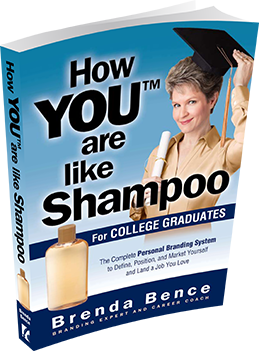
Master the Brand Called You book

How YOU™ are like Shampoo: For College Graduates

Learn Brenda’s powerful step-by-step personal branding process to help you get the job of your dreams upon graduating from university. “Every college grad needs this book!”

Brenda Bence is a globally recognized High-Stakes C-Suite Succession Coach and Executive Leadership Advisor, trusted by the world’s most influential organizations to navigate high-level leadership challenges and pivotal transitions with clarity and confidence.

Honored by Thinkers50 as a Coaching Legend, Brenda is also ranked by Global Gurus as the #3 Executive Coach worldwide and has been inducted into the Professional Speaker Hall of Fame.

With an MBA from Harvard Business School, Brenda built her career leading billion-dollar brands at Procter & Gamble and Bristol-Myers Squibb, where she led businesses with global remits, spanning four continents and 50 countries. Building on her own hands-on leadership experience, she founded Brenda Bence International (“BBI”), now serving clients across six continents, with offices in both the U.S. and Asia.

Visit www.BrendaBence.com to learn more.

Related Articles

Pin It on Pinterest