
Often, when we hear the word “leader,” we think of an individual who leads others. But people leadership is only one part of an executive’s journey. Yes, people-leadership skills are absolutely critical to success … but on their own, they are not enough to help you reach your full potential. Before you can effectively lead subordinates, you must first effectively lead yourself.
Self-leadership is the missing piece for so many executives—a key area of leadership that often gets neglected.
In other words, you cannot successfully manage others until you’re adept at managing your own mindset, actions, and reactions.
How do I know this is true? It has become clear to me in my career as an executive coach, during which I have worked with hundreds of leaders from more than 60 nationalities and a wide variety of industries. Before that, I was an executive myself in multinational corporations, building brands across dozens of countries on four continents.
My first lesson about self-leadership occurred years ago during an unexpected encounter with John Pepper, then-Chairman and CEO of Procter & Gamble (P&G). It was a hot August night in Cincinnati, Ohio, the home of P&G’s world headquarters. I had just flown in the day before from China, where I was living and working for P&G as an expat, to attend a global meeting for the company’s marketing leaders. Once the all-day event was over, I holed myself up in a corner of the darkened 9th floor—my old stomping grounds when I worked there—in order to catch up on emails.
Glancing at my watch, I realized it was almost 9:30 p.m., so I packed up my things to head back to the hotel. Making my way through a half-lit hallway, I reached the elevator bank and pushed the “down” button. As I glanced up, I realized the elevator was descending from the 11th floor.
Back then, the 11th floor of P&G’s world headquarters was called “Mahogany Row” due to the beautiful mahogany desks that graced the space. Those desks belonged to the highest-level leaders in the multibillion-dollar corporation—P&G’s C-Suite Executives: the CEO, the COO, the CFO, the CMO, the CIO, the C-I-E-I-O (you get my drift).
Standing there watching the elevator numbers counting down from 11 … to 10 … to 9, a thought flashed through my mind: “I wonder if anybody from the 11th floor will be sharing the car with me.”
As if on cue, the elevator doors opened, and sure enough, there stood John Pepper. As I stepped inside, it suddenly hit me: I was going to have nine floors—count ‘em, nine—of one-on-one time with the company’s #1 executive.
Because I had presented to John many times, I knew he was aware that I was managing key company brands in Greater China, an important strategic location for the company. I also knew that after 30 hours of long-haul travel and attending an all-day meeting, the pistons of my brain-engine weren’t exactly hitting on all cylinders. That’s when I heard inside my head the wise voice of one of my favorite mentors, saying, “Brenda, always be prepared with a question for upper management in case you run into them. Because if you don’t ask them a question, they will ask you one.”
So, to avoid being faced with a brain-challenging inquiry in my exhausted state, I turned and said, “Good evening, John. It’s nice to see you. Do you mind if I ask you a question?”
“Not at all,” he answered. “Feel free.”
“There’s something I’ve been wondering about,” I said. “I understand what it takes to progress from Assistant Brand Manager to Brand Manager. And I’m clear about what’s required to move from Brand Manager to Associate Marketing Manager and from there to Marketing Manager. I’m even clear on what it takes to advance from Marketing Manager to Marketing Director and from Marketing Director to Vice President. But above those levels, what is required to get promoted from, say, Executive Vice President to Senior Executive Vice President? In other words, at the most senior levels of the company, why do some leaders keep moving up the ladder and others don’t?”
I’ve never forgotten what Mr. Pepper shared with me late that August evening. “Those who do not make it to the highest levels of the organization are the executives who stop being ‘coachable.’ They believe they no longer need to accept feedback. They don’t try to keep learning or growing, and they don’t believe they need to stretch themselves anymore. They sit back, earn the big paycheck, and take in all the perks that come with a grand title. They believe they’ve ‘made it.’ Those are the leaders who don’t last long because being coachable is fundamental to leadership success.”
Mr. Pepper’s powerful advice has influenced me ever since. Since then, I have tried to emulate great self-leaders by initiating a daily habit of asking myself, “How coachable am I today?” And I have suggested that my executive coaching clients do the same.
Break the “CCODE”
I believe great self-leaders also follow what I call the “CCODE,” an acronym that is a recipe for self-leadership success. The ingredients are as follows:
C is first for Courage.
The first step in your evolution as a capable self-leader is taking a good, hard look at yourself—your work habits, your fears, your personal style, your relationships, where you thrive, and where you fall short. A true, no-holds-barred self-assessment takes guts. Confronting yourself and realizing that you have flaws that are holding you back can be painful. It takes courage to open your eyes, look in that mirror, and make changes that will have a powerful impact on your career.
C also stands for Commitment.
Self-leadership isn’t a goal to which you can aspire “a bit.” It’s like being a “little” ethical; you either are, or you aren’t. Once you commit to being coachable—once you say you want to examine yourself and make whatever changes are necessary to be an effective self-leader—then you must devote yourself to the process, embrace it, and keep it at the top of your priority list. It deserves your time, focus, and attention.
O means you are Open
Open to new ideas, new mindsets, and new ways of looking at your life, your work style, and your relationships. You’re also open to changing the way you work. As I mentioned earlier, self-leaders are willing to at least listen to new ideas.
D is for Discipline.
This means putting systems in place and organizing yourself in a way that supports your progress. It involves arranging your schedule to find time for the changes you want to make. Disciplined self-leaders also make regular self-assessments a part of their routine so that they are continually checking progress and making adjustments.
E is for the Energy.
Energy you must devote to this important mission. Don’t underestimate the amount of energy you’ll need to make changes to yourself. It amounts to conscientious self-care, and that’s not something senior executives are always good at. It’s too easy to blow off daily objectives like getting a good night’s sleep, eating healthy foods, and fitting in regular exercise. But you cannot achieve your goals if your body and mind are tired. That’s why this might be the most important CCODE component because, without healthy energy, the other objectives will be out of your reach.
Those are some of the key basic attributes that make for a great self-leader. In my new book, Leading YOU™: The power of Self-Leadership to build your executive brand and drive career success, I reveal the 15 most damaging self-leadership behaviors that I regularly see in my executive coaching practice, and I provide dozens of tips and techniques you can immediately apply to correct or improve these behaviors.
In what ways do YOU want to improve in order to be a better self-leader?
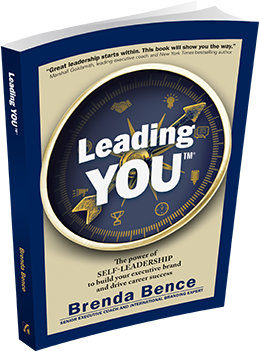
LEADING YOU™
The most important driver of overall success is your own self-leadership. How you lead yourself directly impacts your ability to lead others, and that, in turn, can prevent you from reaching your full potential.
Discover the power of SELF-LEADERSHIP to build your executive brand and drive career success.
 Brenda Bence is a globally recognized High-Stakes C-Suite Succession Coach and Executive Leadership Advisor, trusted by the world’s most influential organizations to navigate high-level leadership challenges and pivotal transitions with clarity and confidence.

