
What is Executive Presence? I have found a lot of confusion among executive coaching clients about the true meaning of this “buzz phrase.” The way I like to define it is: “a set of attitudes, behaviors, and skills which—when combined—send the right signals, influence others, and ultimately drive results.”
If you’re a senior leader, you no doubt already have some degree of Executive Presence. It’s how you’ve reached your current level in the first place. The most admired people have Executive Presence in abundance—people like Nelson Mandela, Oprah Winfrey, and Richard Branson, to name a few. You know when you’ve met someone with powerful Presence. You feel drawn to that person and you want to connect with him or her.
“But can you learn Executive Presence?” clients ask? Yes. And doing so improves your self-leadership, strengthens your executive leadership brand, and helps you advance in your career. Want proof about how important it is? According to a study of 236 senior executives, who make decisions about promotions within their organizations, Executive Presence accounts for more than one-quarter of what they look for in someone who is aiming to reach the next level.
Many similar studies exist, all pointing to one outcome: Executive Presence is fundamental for those who want to reach increasingly higher levels in any organization. And it takes strong self-leadership to stay aware of and demonstrate the specific attitudes, behaviors, and skills required to embody powerful Presence.
So, what can you do to develop powerful Executive Presence? What’s the “secret sauce”?
The Most Important Ingredient of the “Secret Sauce”
I believe that underlying every aspect of Executive Presence is one core element: confidence— the absolute certainty that you can do what it takes to succeed in any situation. When you have confidence, you believe in yourself, so that—even if you’re undertaking something new—you know you’ll be able to figure it out when you get there.
Yet, many accomplished leaders lack the confidence they need to cultivate strong Executive Presence. One indication of that: I’ve met a large number of leaders who suffer from the “Impostor Syndrome.” That’s a term which describes high-achieving people who don’t really trust their successes. They are constantly afraid of being exposed as a fraud, no matter how much they’ve accomplished. “I just got lucky,” they might say. As much as they want a higher level of responsibility or a specific promotion, deep down they question whether they are good enough to get it.
Then, there are other leaders like my client, George, who allowed a setback to damage his confidence. He had 29 years of experience in the corporate world. For 27 of those years, he was a dynamic go-getter, moving up the ladder and achieving great success every step of the way— not just in his professional life, but in his personal life as well. For the last two years, though,things hadn’t gone so well for him.
He had taken over a division that was new to him, and it wasn’t performing well under his leadership. When we met, I could sense George’s energy. He was like a balloon that had been deflated.
“George, for how many years did you have tremendous success?” I asked him.
“Twenty-seven years,” he responded.
“And for how long have things been a bit rocky?”
“These past two years,” George replied
“So, you’ve had 27 years of positive, ongoing successes, and only two years—24 months—of less-than-positive outcomes. Is that correct?”
I could see the realization of this sinking in. “You’re right—I have to keep that in perspective,” George said. “I can’t let these past 24 months cloud a career and a life that has gone so well. It’s only a small portion of the whole.”
George is an example of how quickly confidence can fade if we’re not careful to nurture it. And once confidence fades, Executive Presence takes a hit.
Keep Your Confidence Level Steady
If you take an inventory of your successes and how they came about, you’ll most likely recognize that it was definitely not “all luck.” Your talents, skills, and hard work are why you’ve achieved success.
Here’s an exercise to help you look honestly at what you have done and the skills you’ve developed, while acknowledging what you believe you genuinely lack. Make two columns on a legal pad or on your computer, and on the left-side column, list your most valuable attributes. Don’t stop adding to the list until you’ve run out of qualities and skills (and don’t be humble!).
Then, in the right column, list the areas where you still need work. Be objective about what you could do better. Once done, sit back and review the two lists. If you’re like most of my clients, I suspect you’ll be surprised at the outcome, because we often underestimate what we can do versus what we think we cannot do. (I assigned George this exercise, and this one task alone gave him more momentum than he’d had in a long while.)
It’s critical to look at yourself the way others do, but it’s difficult to see yourself through an objective lens. That’s why it’s so important to getting meaningful feedback—and why I devoted an entire chapter to that topic in my book, Leading YOU™: The power of Self-Leadership to build your executive brand and drive career success.
The single most powerful and productive exercise I give my clients is the task of keeping a “Confidence Journal.” It’s simple: As you go through your day, and you have an experience that either increases or decreases your confidence level, write down what happened and why. Whether you are being challenged by a peer, find yourself on the receiving end of a compliment from the CEO, needing to fire someone, or struggling to influence outcomes, make sure to remain objective, and ask yourself: “What’s happening to my confidence right now?” Go inside and figure out how the experience is impacting you. What’s the context? Who’s involved, and what’s triggering the “boost” or the “bust”? What’s really causing those ups and downs?
Jot every incident down, and give your confidence level a score based on how you feel: 1 = Not feeling confident at all, 10 = Feeling fully confident. Don’t judge yourself as you write—just be objective. Detach emotionally for a moment, and become an impartial reporter of what’s happening inside you, noting what triggered your shift in confidence.
Depending upon how many incidences you have, after a week or two of keeping track, pick up your confidence journal, and look for trends. What do you see, objectively? For example, it might be that your confidence level drops when you address very senior leadership, but you feel fully confident when addressing and leading direct reports.
Or maybe you wrote: “When I’m dealing with peers over whom I have no direct authority, my confidence level drops.”
Or: “When I’m involved in a conversation in my area of expertise, my confidence is high, but when I’m called upon to discuss areas outside my division, my confidence is reduced.”
Some clients keep the journal for two or three weeks, while others like to keep it going for two months or longer. It’s up to you. Once you understand the triggers that are causing confidence highs and lows, you’ll then be better able to preempt the triggers so that you can avoid confidence dips.
If you strengthen your Executive Presence in this way, you’ll be much less likely to allow a setback to diminish your belief in yourself. Keep in mind all of your achievements, and use them to keep you moving forward, even when faced with a challenging situation.
Assess the state of your current Executive Presence by taking my Executive Presence Quiz
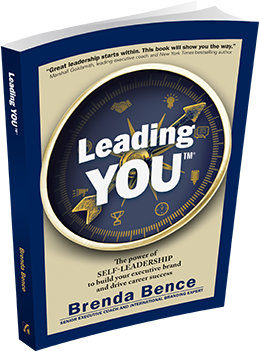
LEADING YOU™
The most important driver of overall success is your own self-leadership. How you lead yourself directly impacts your ability to lead others, and that, in turn, can prevent you from reaching your full potential.
Discover the power of SELF-LEADERSHIP to build your executive brand and drive career success.
 Brenda Bence is a globally recognized High-Stakes C-Suite Succession Coach and Executive Leadership Advisor, trusted by the world’s most influential organizations to navigate high-level leadership challenges and pivotal transitions with clarity and confidence.

