The Single Worst Question a Leader Can Ask

by | Excellence in Leadership

Employers want to know why you are the best choice for the job. Should they hire you or another candidate? But here’s a surprising truth: The person who best connects with the interviewer is most likely to get the job – even over someone who might be more qualified. That’s where your personal brand comes in.

Maybe you’re thinking, “A personal brand? I don’t have one or even want one!” Reality is, though, you do already have a personal brand whether you realize it or not. Just by being you in interviews, on the job, or wherever you present yourself, you have a personal brand. Defined as “the way you want people to perceive, think, and feel about you in relation to others,” your personal brand is alive and well and exists in the minds of other people – including interviewers.
That’s why it’s important to take control of your brand, to make sure you make the impression you want throughout your job search.

So, learning to master your personal brand is key to success, and one way to do that is to avoid the Top 10 Job-Seeker Personal Brand Busters®. These, listed below, are among the most damaging mistakes that job seekers make when looking for a new position. Avoid these Busters™, and you’ll communicate a more powerful personal brand to potential employers before, during, and after your interviews.

In your job search efforts, have you committed any of these Job-Seeker Personal Brand Busters®?

1. Not paying attention to your personal brand on the Internet. Chances are, your interviewer or future boss will search for your name on the Internet prior to your interview. So, think twice before posting those wild photos from Mardi Gras on your Facebook page. If you blog or use Twitter, pay attention to what you say. Avoid writing negative comments about others (especially former employers and coworkers), and steer away from profanity and strong opinions.
2. Not visiting the restroom prior to your interview. Ok, let’s get the obvious out of the way: You definitely don’t want to squirm in your chair because you haven’t had time to go to the restroom before the interview! But you should also use a quick pop into the restroom to make sure your hair is neat, your suit hasn’t picked up any lint, and everything is in its proper place.
3. Answering a question without taking the time to think or before fully understanding the question. Let’s say you’re in an important interview, and you’re asked a question that takes you by surprise. You’re not sure how to respond, but you feel you need to say something right away to make you look confident. So, you just start babbling, spouting out whatever comes to mind. The truth is that interviewers actually prefer that you pause for a few seconds to think of a good answer before you speak. If you rush to answer every question, you run the risk of saying something you don’t really mean.
4. Only looking at one interviewer when there are two or more interviewers in the room. Job seekers tend to look at the interviewer who is most expressive or seems the most receptive. But if you’re interviewed by more than one person, make sure you look at everyone in the room when you speak. Make eye contact with one interviewer for a few seconds, then shift to another and another in order to connect with all of them.
5. Talking only about what you want out of the job and not what the company needs or wants. The employer is more interested in what you can do for the company and not vice versa. If you’re asked in the interview what you want from the job, answer the question intelligently, but don’t go on and on about all that you’re hoping the company can offer you.
6. Speaking negatively about your current or former employer. This was confirmed in a survey of interviewers and recruiters conducted by CareerBuilders.com where 49% said that the worst interview offense is speaking negatively about a former boss. Saying something mean-spirited about a former employer will leave a bad taste in an interviewer’s mouth, so find a way to shed some positive light on your current or previous company and boss.
7. Asking questions about pay and benefits during an initial interview. Recruiters say they immediately read that kind of question as a sign of someone with little experience. It’s okay to ask an employment agent or recruiter about salary and benefits, but an initial interview isn’t the right time to ask those questions unless the interviewer brings it up. You can cover those subjects once you’re further along the interview process.
8. Not asking questions in a way that helps sell yourself. Ask questions in a way that highlights your strengths. For example, you could ask something like: “Given my experience managing big projects in my current job, do you see opportunities for someone like me to take on a project manager role here, too?”
9. Not being prepared with good, thoughtful questions to ask at the end of an interview. Being prepared with smart questions about the company and the job will show you’ve done your research. It demonstrates that you want to be a part of the organization and that you’re taking the process seriously.
10. Beating yourself up if you don’t do well in an interview or if you don’t get the job. You may have done better in the interview than you think, and the company’s reasons for not choosing you may have nothing to do with you at all. The company might have decided to eliminate the position entirely, or they may have chosen someone from within. So, don’t let a less-than-stellar experience turn you into a pessimist. Stay positive! Evidence shows that people who are optimistic about their job search actually get jobs more quickly.

Asking your direct reports questions rather than always telling them what to do is a key way to develop their abilities and help them grow. That said, there is one question-word in your leadership tool chest that I suggest eliminating altogether:

“Why”

Why? (Couldn’t resist… ) The very nature of the question causes defensiveness. Even the most seemingly innocuous questions like “So, why are you wearing that tie today?” or “Why did you go to Frankfurt last week?” can get the most mild-mannered employees feeling as though they need to defend themselves.

There’s nothing positive about the defensiveness that results when a “why” question is asked. In fact, depending on the specifics of the question, asking “why” can imply blame, create suspicion, and break down trust. It fosters an immediate “you vs. me” atmosphere and can even subconsciously put people into fight-or-flight mode. I’ve seen “why” questions create antagonistic relationships and cause otherwise dependable employees to hide information from their bosses.

“Why” questions also tend to keep you in the past. Try asking a “why” question that is focused positively toward the future. I don’t think it’s possible. That’s because “why” is most often about what happened yesterday or about a problem happening today. It’s rarely about what can be done to find a solution to a problem or move toward a positive future state.

For example, questions like, “Why did you do it that way?” or “Why are you late?” are destructive because the recipient of the question will no doubt feel put down and/or guilty and defensive. These “why” questions do nothing to help motivate and find constructive new ways of thinking and moving forward positively into the future.

“What” and “How” Questions

Instead, results come when leaders replace “why” questions with “what” and “how” questions.

Here are a couple of examples:

“Why” Question: “Why isn’t this work completed yet?”
“What” or “How” Question: “What resources would it take to get this work done today?

“Why” Question: “Why did you do it that way?”
“What” or “How” Question: “How will the approach you chose help us reach our objective for this project?”

These types of “what” and “how” questions lead to powerful and innovative thinking, proactive planning, and visioning for the future.

Be careful, though! “What” and “how” questions can sometimes be “why” questions in sheep’s clothing. For example, nicer-sounding phrases like, “What’s the basis of your thinking?” or “What caused you to be late today?” may start with the word “what” but are simply “why” questions in hidden form.

The Power of Eliminating “Why”

Deborah was the head of internal audits for a large multinational corporation. During our first coaching session, she shared openly, “I’m not happy in my job, and the morale of my team is low, too. I feel that my direct reports and I all have fairly combative relationships with other departments in the organization.”

“Tell me more about what you and your team do, Deborah. What’s your day-to-day work like?”I asked.

“Well, from others’ perspectives, there’s nothing particularly ‘fun’ about what we do when conducting an audit. Throughout the organization, everybody dreads our arrival like a root canal because it’s our job to investigate what they might be doing wrong and then tell them to correct it. We sometimes need to report big discrepancies to the Board, and the entire company knows that. I feel like we’ve been branded the ‘ugh! people’… when we show up, everyone says ‘ugh!'”

Through probing to better understand her existing challenge, Deborah revealed that a standard discussion with the company’s internal auditing clients often relied primarily on “why” questions to carry out their auditing work. “Why did you take that approach?” and “Why didn’t you follow the agreed-to process?” were the typical types of questions asked by Deborah and her team.

Once the problem became clear, Deborah and I practiced several examples of how she and those in her division could replace “why” queries with “what” and “how” questions. For example, rather than ask, “Why did you do it that way?” Deborah’s team of auditors could ask, “How does the process you used support your long-term objectives?” A question like, “Why didn’t you follow standard operating procedures?” could be replaced with, “How well did the process work for you given it was not the normal protocol?”

Armed with this new way of forming questions, Deborah and her team immediately shifted the way they interacted with their internal auditing clients. The outcome? When the auditors arrived on the scene, company employees had a much less negative attitude toward them and began to see the auditing team as there to help rather than judge. Within just 60 days, members of the auditing department reported being able to build better, more trusting relationships across the organization, and the morale of Deborah’s team improved.

As a big plus, the auditing team members shared with Deborah that they were also receiving more honest answers to their non-threatening, open-ended questions – the kind of information that actually helped them perform their jobs better.

What about you? Begin to notice how you phrase questions of colleagues and team members and make adjustments as necessary. They will most likely respond more positively if you say goodbye to “Why.”
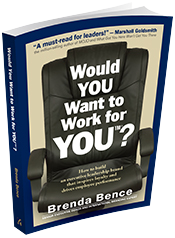
Would You Want to Work For You Book

WOULD YOU WANT TO WORK FOR YOU™®?

Discover how to build an executive leadership brand that inspires loyalty and drives employee performance.

As a senior leader wanting to release your team’s productivity and advance to the top echelons of your industry, it’s vital to start by looking inward.

Brenda Bence is a globally recognized High-Stakes C-Suite Succession Coach and Executive Leadership Advisor, trusted by the world’s most influential organizations to navigate high-level leadership challenges and pivotal transitions with clarity and confidence.

Honored by Thinkers50 as a Coaching Legend, Brenda is also ranked by Global Gurus as the #3 Executive Coach worldwide and has been inducted into the Professional Speaker Hall of Fame.

With an MBA from Harvard Business School, Brenda built her career leading billion-dollar brands at Procter & Gamble and Bristol-Myers Squibb, where she led businesses with global remits, spanning four continents and 50 countries. Building on her own hands-on leadership experience, she founded Brenda Bence International (“BBI”), now serving clients across six continents, with offices in both the U.S. and Asia.

Visit www.BrendaBence.com to learn more.

Related Articles

Pin It on Pinterest